
Ribbon Mixers, Ribbon Blenders & Vertical Ribbon Mixers
Not all ribbon mixers are the same. Ribbon width, pitch and swept surface area decide how fast a batch reaches uniformity — and whether it stays uniform on discharge. This is how we engineer that geometry, from 5 to 30,000 litres.
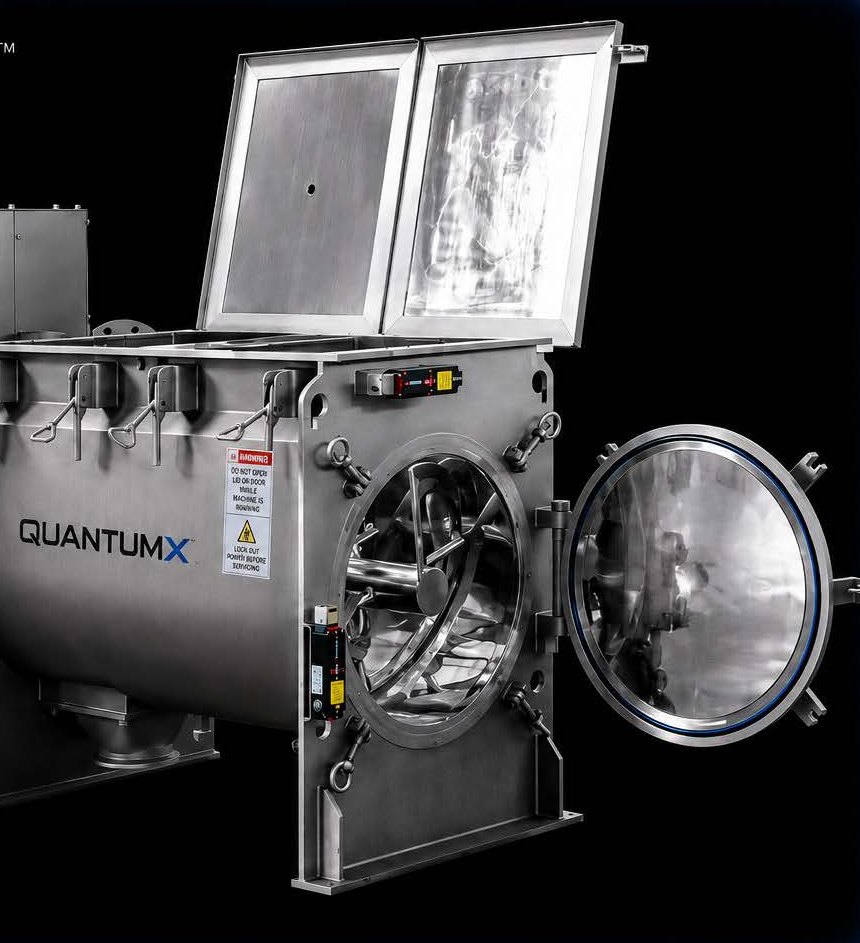
This page covers QuantumX standard atmospheric ribbon mixers. Every QuantumX geometry — paddle, plow, double cone, V-blender, fluidized zone, hi-speed granulator, conical, drum, planetary and sigma — is likewise available as a standard atmospheric mixer; ask for standard-model specifications. For drying duties, see the vacuum executions.
How a Ribbon Mixer Works
A ribbon agitator is a pair of nested helices turning on one shaft. The outer helix conveys product axially in one direction; the inner helix, wound the opposite hand at a smaller diameter, returns it. The two flows meet and fold continuously — convective macro-mixing — while the trough wall and the ribbon's radial clearance produce the shear that breaks down agglomerates. Uniformity is reached by displacement, not by violence, which is why ribbon mixers hold friable particles and coated granules intact.
Axial Transport
The outer ribbon moves the bulk of the charge end-to-end. Its pitch sets how far product travels per revolution — and therefore how many passes a batch makes per minute.
Counter-Current Return
The inner ribbon returns roughly the same mass flow against it. The opposing streams create the shear plane where minor ingredients are distributed.
Radial Exchange
Ribbon width and clearance to the wall govern the thin layer scraped and lifted each pass — the mechanism that eliminates dead zones at the trough radius.
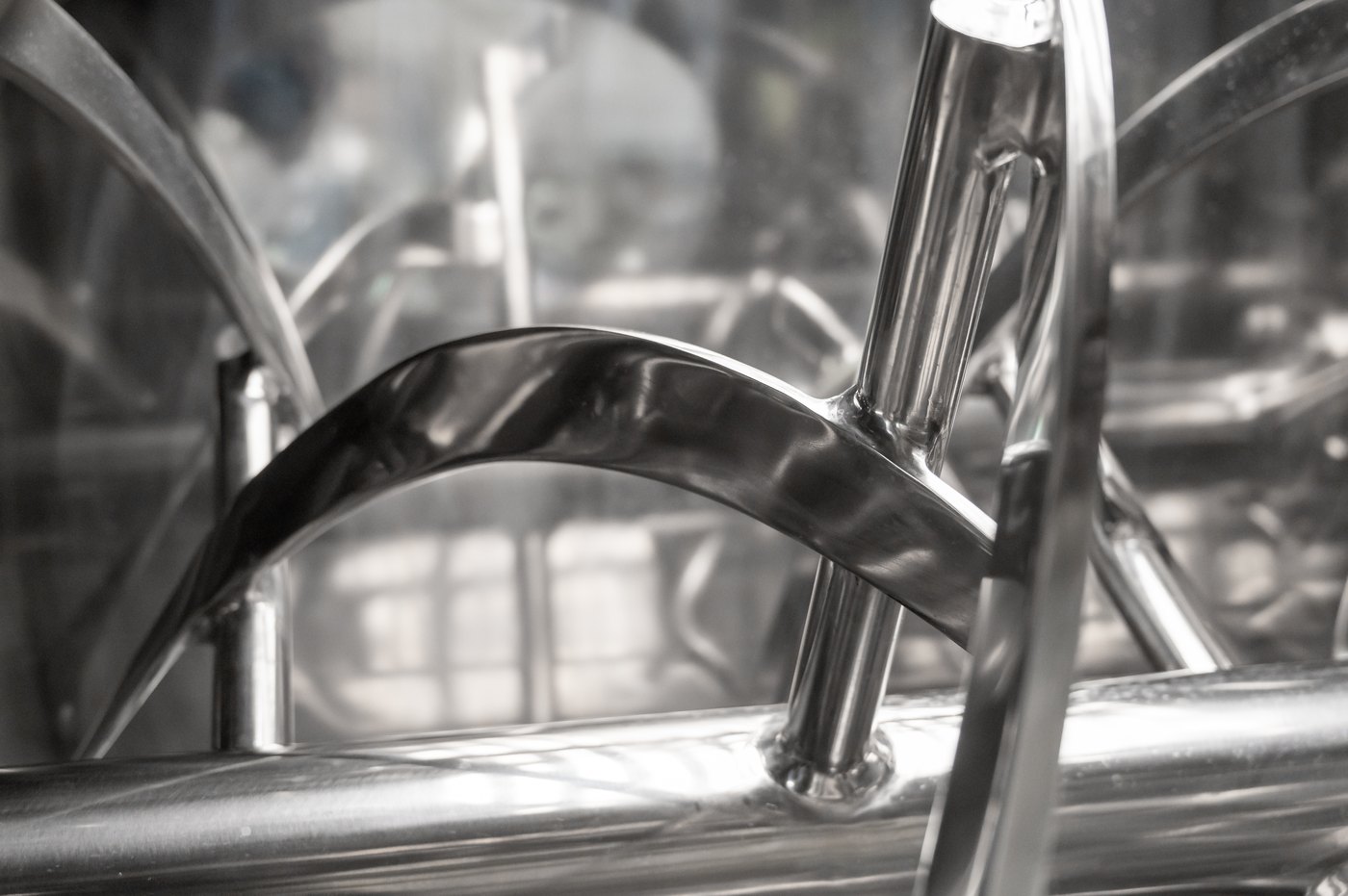
Blend time is set by the number of complete circulations, not by elapsed minutes. Two geometries at the same RPM can differ by 3× in circulations per minute. Specifying RPM without specifying pitch and ribbon width tells you almost nothing about mixing performance.
Matching Ribbon Geometry to the Product
Quoted volume, motor power and RPM are the three numbers most often compared — and the three least predictive of blend quality. The table below is the starting point our engineers work from; final geometry is confirmed against a sample of your material.
| Product Character | Ribbon Config. | Flight Width | Pitch | Tip Speed | Typical Blend Time |
|---|---|---|---|---|---|
| Free-flowing dry powders | Standard double ribbon | 0.10 – 0.12 D | 1.0 D | 1.6 – 2.2 m/s | 3 – 6 min |
| Cohesive / fine powders < 20 µm | Intermeshing double ribbon | 0.08 – 0.10 D | 0.6 – 0.8 D | 2.0 – 2.6 m/s | 6 – 12 min |
| Friable granules, coated pellets | Single ribbon with rods | 0.14 – 0.18 D | 1.0 – 1.2 D | 1.0 – 1.5 m/s | 4 – 8 min |
| Micro-ingredients at < 0.1% w/w | Double ribbon + chopper | 0.10 D | 0.7 D | 2.0 – 2.6 m/s | 8 – 15 min |
| Powder + liquid, 5 – 25% addition | Ribbon + paddle combo | 0.12 D | 0.6 D | 1.6 – 2.0 m/s | 8 – 20 min |
| Pastes, doughs > 50,000 cP | Heavy paddle-ribbon | 0.16 – 0.20 D | 0.5 D | 0.8 – 1.2 m/s | 10 – 25 min |
| Abrasive minerals, hard granules | Double ribbon, hardfaced | 0.12 D | 1.0 D | 1.2 – 1.6 m/s | 4 – 8 min |
Radial Clearance
Outer flight to trough wall is held at 3 – 8 mm depending on diameter and particle size. Too tight and abrasive particles gall the wall; too loose and a stagnant film survives every pass — the usual cause of a batch that will not close the last percent of CV.
Fill Ratio
Horizontal troughs mix correctly between 40% and 70% of total volume. Below 40% the charge sits under the shaft and axial flow collapses; above 70% the bed cannot lift and mixing degrades to slow diffusion. Every model below is tabulated at both bounds.
On every QuantumX quotation the ribbon set is defined by flight width, inner and outer pitch, radial clearance and calculated tip speed — the numbers that let you compare machines rather than brochures.
Horizontal vs. Vertical Ribbon Mixers
Both geometries reach the same uniformity target. They differ in how fast they get there, what they cost in floor space, and how much stress they put on the particle.
Horizontal Ribbon Mixers · PRB
A U-shaped trough with a nested double-helix agitator on a single horizontal shaft. This is the reference design for bulk blending — strong axial and radial exchange at low tip speed, and full-length discharge that empties the batch without a residual heel.
- Fastest route to CV < 5% on most dry blends
- Complete discharge through full-length bomb-bay doors
- Low headroom — fits under existing silos and bag dumps
- Widest option set: jackets, chopper, liquid injection, vacuum
- Handles pastes and high liquid loads other geometries cannot
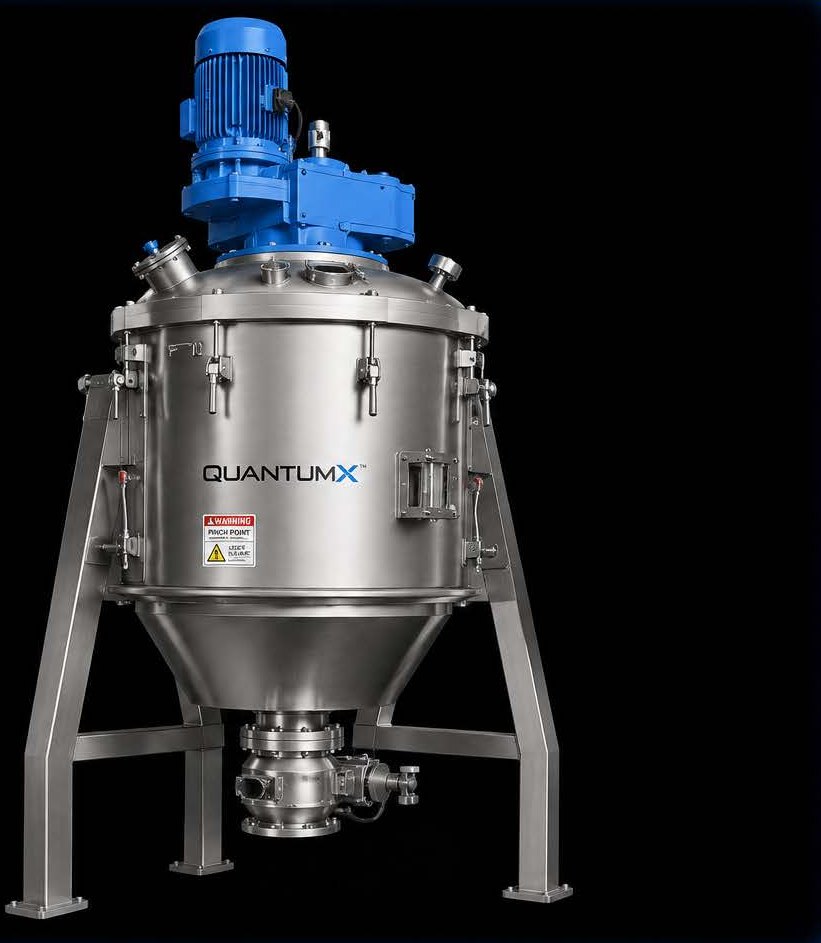
Vertical Ribbon Mixers · PVR
A conical or cylindrical vessel with a vertical helical ribbon. Product is lifted at the wall and cascades down the centre under gravity — mixing energy per unit mass is low and particle damage is minimal, on the smallest floor footprint per litre.
- Smallest floor footprint per litre
- Gentlest action — lowest attrition of fragile particles
- Gravity discharge, no residual heel in a conical bottom
- Tolerates part-batches down to ~30% fill
- Lower installed power for the same volume
| Attribute | Horizontal · PRB | Vertical · PVR |
|---|---|---|
| Mixing action | Counter-current axial + radial, forced | Wall-lift and gravity cascade |
| Typical blend time | 3 – 8 min | 8 – 20 min |
| Tip speed | 1.2 – 2.6 m/s | 0.8 – 1.6 m/s |
| Particle attrition | Low to moderate; geometry-dependent | Lowest of any ribbon geometry |
| Working fill window | 40 – 70% | 30 – 70% |
| Floor area, 1,000 L | Larger — long trough plus drive | Roughly 40% of the horizontal |
| Installed power, 1,000 L | 11 kW | 7.5 kW |
| Discharge | Full-length bomb-bay or slide gate | Gravity through bottom valve |
| Liquid addition | Up to 25%+ with paddles and chopper | Light additions only, ≤ 5% |
| Jacketed heating / cooling | Highest heat-transfer area per litre | Available; lower area per litre |
| Vacuum execution | PRBD series | PVRD series |
| CIP / cleanability | Good with spray bars and stub shaft | Excellent — self-draining vessel |
| Best fit | Large dry blends, wetted and thermal duties, fastest cycle | Tight floor space, fragile or segregating product, small-mid batches |
Horizontal Ribbon Mixers · PRB Series
Dimensions in mm. Working volumes tabulated at 40% and 60% of total. kW and RPM are standard executions; jacketed, vacuum and high-viscosity duties are rated separately. Mixers can be built to a total volume of up to 30,000 L.
| Model | Total L | Work. 40% | Work. 60% | kW | RPM | L | W | H | kg |
|---|---|---|---|---|---|---|---|---|---|
| PRB-5L-CP | 5 | 2 | 3 | 1.1 | 365 | 950 | 400 | 610 | 110 |
| PRB-10L-CP | 10 | 4 | 6 | 1.1 | 365 | 1,050 | 400 | 610 | 120 |
| PRB-15L-CP | 15 | 6 | 9 | 1.1 | 280 | 1,150 | 450 | 640 | 140 |
| PRB-20L-CP | 20 | 8 | 12 | 1.1 | 280 | 1,250 | 500 | 670 | 160 |
| PRB-30 | 30 | 12 | 18 | 1.5 | 123 | 940 | 800 | 1,130 | 250 |
| PRB-45 | 45 | 18 | 27 | 1.5 | 123 | 940 | 850 | 1,160 | 260 |
| PRB-50 | 50 | 20 | 30 | 2.2 | 110 | 1,000 | 900 | 1,200 | 350 |
| PRB-60 | 60 | 24 | 36 | 2.2 | 110 | 1,000 | 950 | 1,200 | 450 |
| PRB-70 | 70 | 28 | 42 | 2.2 | 85 | 1,150 | 980 | 1,250 | 550 |
| PRB-100 | 100 | 40 | 60 | 2.2 | 85 | 1,410 | 600 | 1,650 | 600 |
| PRB-150 | 150 | 60 | 90 | 3 | 80 | 1,450 | 650 | 1,680 | 620 |
| PRB-200 | 200 | 80 | 120 | 3 | 70 | 1,570 | 660 | 1,710 | 650 |
| PRB-250 | 250 | 100 | 150 | 4 | 65 | 1,680 | 700 | 1,750 | 700 |
| PRB-300 | 300 | 120 | 180 | 4 | 65 | 1,700 | 715 | 1,760 | 750 |
| PRB-400 | 400 | 160 | 240 | 5.5 | 60 | 1,850 | 800 | 1,900 | 850 |
| PRB-500 | 500 | 200 | 300 | 5.5 | 60 | 1,980 | 870 | 2,020 | 950 |
| PRB-600 | 600 | 240 | 360 | 7.5 | 60 | 2,100 | 900 | 2,090 | 1,050 |
| PRB-700 | 700 | 280 | 420 | 7.5 | 60 | 2,200 | 920 | 2,100 | 1,150 |
| PRB-750 | 750 | 300 | 450 | 7.5 | 60 | 2,210 | 960 | 2,150 | 1,250 |
| PRB-800 | 800 | 320 | 480 | 11 | 52 | 2,350 | 1,000 | 1,765 | 1,350 |
| PRB-1000 | 1000 | 400 | 600 | 11 | 40 | 2,400 | 1,050 | 1,765 | 1,450 |
| PRB-1200 | 1200 | 480 | 720 | 15 | 40 | 2,600 | 1,100 | 1,800 | 1,600 |
| PRB-1500 | 1500 | 600 | 900 | 15 | 40 | 2,670 | 1,150 | 1,870 | 1,700 |
| PRB-2000 | 2000 | 800 | 1200 | 15 | 35 | 2,920 | 1,250 | 1,980 | 2,250 |
| PRB-2500 | 2500 | 1000 | 1500 | 18.5 | 35 | 3,200 | 1,350 | 2,100 | 2,600 |
| PRB-3000 | 3000 | 1200 | 1800 | 18.5 | 35 | 3,320 | 1,400 | 2,150 | 2,800 |
| PRB-4000 | 4000 | 1600 | 2400 | 22 | 30 | 3,660 | 1,520 | 2,290 | 3,900 |
Vertical Ribbon Mixers · PVR Series
Dimensions in mm. Working volumes tabulated at 30% and 70% of total. Height excludes the discharge valve and support stand.
| Model | Total L | Work. 30% | Work. 70% | kW | RPM | Dia. | H | kg |
|---|---|---|---|---|---|---|---|---|
| PVR-15 | 15 | 4 | 10 | 0.75 | 108 | 450 | 1600 | 150 |
| PVR-20 | 20 | 6 | 14 | 0.75 | 90 | 550 | 1800 | 200 |
| PVR-30 | 30 | 9 | 21 | 1.1 | 90 | 550 | 1800 | 280 |
| PVR-45 | 45 | 14 | 32 | 1.1 | 80 | 655 | 1900 | 350 |
| PVR-50 | 50 | 15 | 35 | 1.1 | 80 | 655 | 1900 | 400 |
| PVR-60 | 60 | 18 | 42 | 1.1 | 78 | 720 | 1900 | 450 |
| PVR-70 | 70 | 21 | 49 | 1.5 | 77 | 720 | 1900 | 550 |
| PVR-100 | 100 | 30 | 70 | 1.5 | 69 | 720 | 1900 | 600 |
| PVR-150 | 150 | 45 | 105 | 2.2 | 62 | 875 | 2200 | 700 |
| PVR-200 | 200 | 60 | 140 | 2.2 | 57 | 875 | 2200 | 800 |
| PVR-250 | 250 | 75 | 175 | 3 | 53 | 980 | 1900 | 420 |
| PVR-300 | 300 | 90 | 210 | 3 | 51 | 980 | 1900 | 450 |
| PVR-400 | 400 | 120 | 280 | 4 | 44 | 1160 | 2100 | 500 |
| PVR-500 | 500 | 150 | 350 | 4 | 43 | 1160 | 2100 | 550 |
| PVR-600 | 600 | 180 | 420 | 4 | 40 | 1500 | 2300 | 700 |
| PVR-700 | 700 | 210 | 490 | 5.5 | 39 | 1500 | 2300 | 820 |
| PVR-750 | 750 | 225 | 525 | 5.5 | 39 | 1500 | 2300 | 950 |
| PVR-800 | 800 | 240 | 560 | 5.5 | 35 | 1500 | 2300 | 1100 |
| PVR-1000 | 1000 | 300 | 700 | 7.5 | 33 | 1525 | 2600 | 1350 |
| PVR-1200 | 1200 | 360 | 840 | 7.5 | 31 | 1680 | 2800 | 1600 |
| PVR-1500 | 1500 | 450 | 1050 | 11 | 29 | 1680 | 2800 | 1800 |
| PVR-2000 | 2000 | 600 | 1400 | 15 | 29 | 1860 | 3100 | 2000 |
Engineered Options & Materials
Ribbon Configurations
Standard double ribbon, single ribbon with rods, intermeshing double ribbon, and paddle-ribbon combination. Pitch, flight width and clearance set per product.
Stub-Shaft Agitator
No flanges or bolts inside the mixing zone. Removes contamination traps, allows front or rear drive, and cuts cleaning time in food, dairy and pharma duties.
Tilting Execution
The whole chamber tilts electrically for complete discharge and open-access washdown. Suited to short-run multi-batch production and cook & chill.
Clean-in-Place
Static or rotary spray balls, programmable rinse–wash–sanitise cycles, stainless plumbing with quick-disconnects, and sloped drainage so nothing pools.
Liquid Addition
Dosing ports with spray nozzles for oils, binders and flavours; high-speed choppers to emulsify liquid into powder; steam injection for cook or sterilisation.
Shaft Sealing
Packed gland, air-purge positive-pressure barrier, or double mechanical seal. Air purge keeps fines, vapours and abrasives out of the seal housing.
| Material | Selected For | Typical Industries |
|---|---|---|
| SS 304 | General-purpose, food-safe, mild chemical exposure. Economical where corrosion is not the driver but sanitary design is. | Food, agriculture, pet food |
| SS 316 / 316L | Superior corrosion resistance in chloride-rich and acidic service; polished to Ra ≤ 0.8 µm for hygienic duty. | Pharma, nutraceutical, chemical |
| Hastelloy | Extreme chemical resistance — strong acids, solvents and oxidisers. | Specialty chemical, battery |
| Hardox® | Wear and friction resistance for abrasive powders and minerals; hardfaced flight edges available. | Cement, ceramics, building materials |
| Titanium | Lightweight with corrosion and high-temperature resistance where stainless is insufficient. | Marine, aggressive process chemistry |
| Carbon steel | Budget option for non-corrosive, non-sanitary service; epoxy or rubber lining available. | Industrial powders, agriculture |
Ribbon Mixer Questions, Answered
What is the correct fill level for a ribbon blender?
Horizontal ribbon mixers blend correctly between 40% and 70% of total vessel volume. Below 40%, the charge sits under the shaft and axial flow collapses; above 70%, the bed cannot lift and mixing degrades to slow diffusion. Vertical ribbon mixers tolerate part-batches down to about 30% fill.
How long does a ribbon blender take to mix?
A correctly engineered horizontal ribbon mixer reaches CV < 5% in 3–8 minutes on free-flowing dry powders. Cohesive fines, micro-ingredients and wetted blends run 6–20 minutes. Blend time is governed by circulations of the batch, not elapsed time — geometry matters more than RPM.
What blend uniformity can a ribbon mixer achieve?
QuantumX ribbon mixers are validated to a coefficient of variation (CV) below 5% on most dry blends, measured by thief-probe sampling with 10 points per interval. The CV target, sampling method and mix time are established in trial and written into the purchase order as acceptance criteria.
Can a ribbon mixer handle liquid addition?
Yes. Horizontal ribbon mixers with paddle-ribbon executions and high-speed choppers handle liquid additions up to 25% and more — for coating, granulation and paste duties. Vertical ribbon mixers are limited to light additions of roughly 5%.
What sizes do QuantumX ribbon mixers come in?
Standard PRB horizontal models run from 5 L bench machines to 4,000 L, and PVR vertical models from 15 L to 2,000 L — with custom builds to 30,000 L total volume.
Trial. Specify. FAT.
Pilot machine, your material, CV curve measured — then geometry, materials, thermal and vacuum scope fixed, and the production machine tested against the same acceptance criteria before shipment.
Request a Quote Download the Ribbon Mixer Brochure