
Vacuum V-Blenders & Dryers
The twin-shell V geometry splits and recombines the batch with every rotation — the fastest diffusive tumble action, now in a jacketed, vacuum-rated execution. Blend, dry and deaerate pharmaceutical and fine-chemical powders with essentially zero shear.
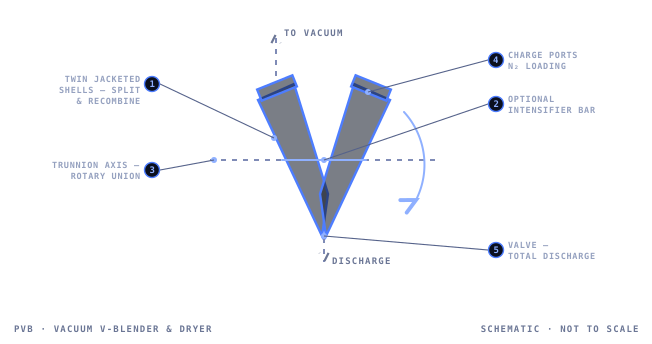
The Mixing Action
Split & Recombine
Each rotation divides the batch into the two shells and recombines it at the junction — a statistically efficient diffusive mechanism that reaches uniformity in fewer turns than a plain drum.
Vacuum & Thermal Shell
Jacketed shells and low absolute pressure dry the blend after it is uniform — or strip residual solvent from an already-dry API — in the same rotation cycle.
Intensifier Bar Option
A liquid-dispersing/de-lumping bar through the trunnion adds just enough energy for minor-ingredient dispersion or light agglomerate breakage without abandoning low-shear behaviour.
Where the PVB Series Earns Its Place
Strengths
- Fast diffusive blending with essentially zero attrition
- Blend and dry in the same vessel — no transfer, no re-segregation
- No product-zone shaft seal without the intensifier option
- Preferred pharma geometry — simple validation and total discharge
- Nitrogen loading and inert operation available
Typical Duties
- Final blending and lubrication of pharma granulates
- Post-blend drying and solvent stripping
- Deaeration of low-density powders
- Fragile and segregating blends
- Small-lot high-value specialty powders
Industries
- Pharmaceutical
- Nutraceutical
- Fine chemicals
- Cosmetic powders
Standard sizes, working volumes, heated areas and installed power for the PVB Series are issued as an engineering datasheet, matched to your material. Request the PVB datasheet »
V-blenders are commodity; vacuum V-blender/dryers are not. QuantumX engineers the fill fraction, rotation speed and jacket duty around your blend — and validates uniformity by thief-probe CV and drying by measured LOD curve before the machine is quoted.
Mix, Dry, React — One Vessel, Under Vacuum
At 10–100 mbar absolute, water boils between 7 °C and 46 °C — so heat-sensitive product dries at temperatures a conventional dryer cannot approach. Every QuantumX vacuum machine shares the same engineering: ASME jackets, vacuum-rated bodies, closed-loop solvent recovery, nitrogen back-fill for oxygen-free processing, and product-temperature control with full batch data logging. How vacuum drying works »
One Vessel, Three Duties
Mix, react or granulate, then dry to spec — no transfer, no loss, no re-segregation.
Solvent Recovery
Condenser, receiver and cold trap sized to the duty; solvents come back as liquid.
Oxygen-Free
Evacuate and back-fill with N₂; ATEX and inert-loop control available.
Validated Cycles
Drying curve and endpoint measured in trial, warranted at FAT.
V-blenders are also built as standard atmospheric mixers — the same engineered geometry, jacket options and trial validation, without the vacuum train. Specify at enquiry.
In the Shop & In the Field
V-Blender Dryers, Answered
What is a vacuum V-blender dryer?
A twin-shell V-blender built as a jacketed, vacuum-rated vessel. It blends by tumble diffusion and then dries or deaerates the batch under 10–100 mbar without transferring the product.
What fill level does a V-blender need?
50–60% of total volume is the efficient window; overfilling suppresses the split-recombine mechanism and stretches blend time.
When is the intensifier bar needed?
For dispersing liquids or breaking soft agglomerates during blending. Pure tumble operation remains available with the bar stationary.
Explore the full range: all vacuum powder mixers & dryers »
Prove It on Your Material First
Pilot trial, your product, measured drying curve and blend data — then geometry, thermal and vacuum scope fixed, and FAT against the same criteria.
Request a Quote