
Vacuum Ribbon Mixers & Dryers
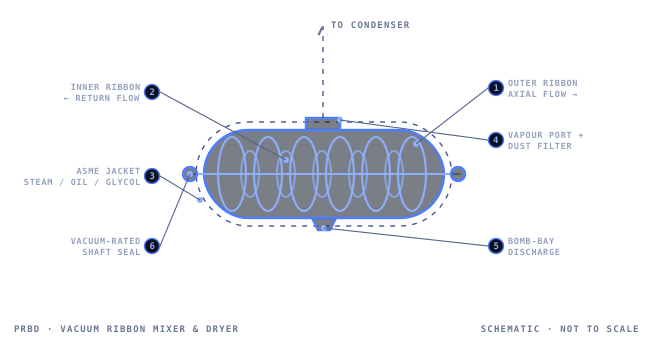
Pull the vessel down to 10–100 mbar absolute and water boils between 7 °C and 46 °C. That single fact is why a vacuum ribbon mixer/dryer can strip moisture or solvent from a heat-sensitive product at jacket temperatures a conventional dryer cannot approach — while the ribbon keeps the bed turning so every particle sees the heated wall and no crust forms.
Lower the Pressure, Lower the Boiling Point
| Absolute Pressure | Water Boils At | Typical Use |
|---|---|---|
| 1013 mbar | 100 °C | Atmospheric reference |
| 200 mbar | 60 °C | Light de-dusting, degassing |
| 100 mbar | 46 °C | Food powders, botanicals |
| 50 mbar | 33 °C | Proteins, enzymes, probiotics |
| 20 mbar | 18 °C | APIs, solvent recovery |
| 10 mbar | 7 °C | Battery materials, deep drying |
One Vessel, Three Duties
Mix, react or wet-granulate, then dry to final moisture without transferring product. Fewer transfers means less exposure, less loss and no re-segregation between steps.
Vapour Recovery
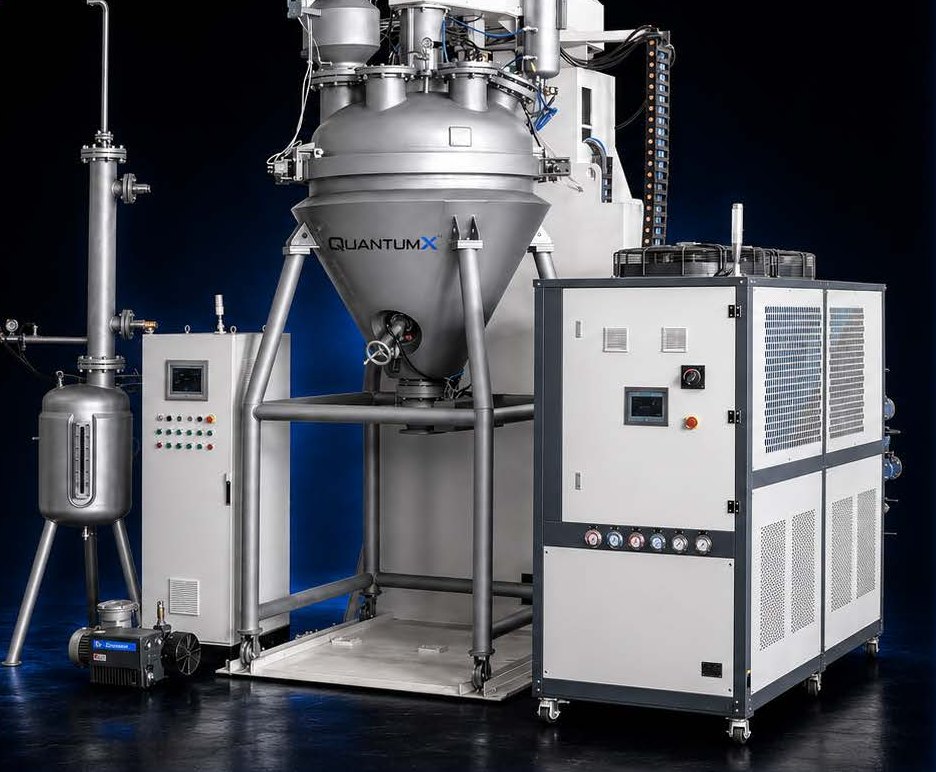
Shell-and-tube or plate condenser, receiver and cold trap sized to the evaporation duty. Solvents are recovered as liquid for reuse rather than vented.
Oxygen-Free Processing
Evacuate and back-fill with nitrogen for oxidation-sensitive or dust-explosive products. ATEX execution and inert-loop control available.
Saturation temperature of water. Solvent systems follow their own vapour-pressure curve — specify the solvent at enquiry.
Where Vacuum Mixing and Drying Is Used
Vacuum earns its capital wherever the product is worth more than the energy, degrades with heat, or carries a solvent that has to come back.
Pharmaceutical & API
Wet granulation followed by in-vessel drying to target LOD. Solvent recovery under closed loop, containment to OEB levels, full CIP and validation documentation.
10 – 30 mbar · Jacket 40 – 60 °CNutraceutical & Protein Powders
Drying botanical extracts, probiotics and whey or plant protein isolates without denaturation or loss of viable count. Colour and aroma retained.
30 – 80 mbar · Product ≤ 45 °CFood & Beverage
Flavour and seasoning bases, instant powders, fruit and vegetable powders, pet-food premixes. Cook under jacket, flash-cool under vacuum, discharge stable.
50 – 150 mbar · Cook & ChillBattery & Energy Materials
Cathode and anode precursor drying to single-digit ppm moisture, NMP and solvent recovery, electrode slurry pre-mix. Inert atmosphere throughout.
≤ 10 mbar · N₂ Back-fillSpecialty Chemicals
Pigments, catalysts, resins and intermediates. Reaction under vacuum with controlled heat input, then dry and cool in the same body. Hastelloy and titanium available.
10 – 100 mbar · Solvent RecoveryPlastics, Polymers & Minerals
Drying and degassing of resins, masterbatch and additive blends before extrusion; moisture control in technical ceramics and fine mineral powders.
50 – 200 mbar · Jacket to 150 °CTemperature Control: Heating, Cooling, Vacuum
In a powder bed, conduction is slow and the product only heats where it touches metal. A jacketed ribbon mixer solves that by constantly renewing the layer at the wall — the agitator is the heat-transfer device as much as the jacket is. Add vacuum and you gain a second, independent control: the boiling point itself.
Heating
Steam, thermal oil or electrically heated fluid through a dimpled, half-pipe or limpet-coil jacket on trough and end plates. Hollow-shaft and hollow-ribbon execution adds interior heating surface where duty demands it.
Steam to 150 °C · Oil to 250 °C · Electric to 200 °CCooling
Chilled water or glycol through the same jacket circuit. Used to pull cooked product down to a safe packing temperature, to remove frictional heat from long mixes, and to hold exothermic reactions inside their window.
Chilled water to 4 °C · Glycol to −20 °C · CO₂ optionalVacuum as Thermal Control
Lowering pressure lowers the boiling point, so moisture leaves at a temperature the product can survive. It also removes the entrained air that insulates particles, which measurably improves wall-to-bed heat transfer.
10 – 200 mbar · Boiling point 7 – 60 °C · Flash-coolingJacket Construction & Control
- ASME-certified jackets rated to 6 bar (90 PSI); dimple, half-pipe or limpet coil selected by duty and fluid
- Hollow shaft and hollow ribbon options raise heat-transfer area per litre by up to 45%
- Jacket zoning on trough, end plates and doors so the whole wetted wall is active, not just the barrel
- Product RTDs in the bed, not only in the jacket — control on product temperature
- PLC recipe control of ramp, soak, cool and vacuum set-points with batch data logging
- Rock-wool or aerogel insulation with stainless cladding; surface held below 60 °C for operator safety
Ready meals, sauces, soups, pet food and confectionery bases are cooked to temperature under steam, held, then cooled to packing temperature on the same circuit — no transfer, no second vessel, and a documented thermal record for the lot.
Ribbon mixers are also built as standard atmospheric mixers — the same engineered geometry, jacket options and trial validation, without the vacuum train. Specify at enquiry.
Ribbon Mixer vs. Vacuum Ribbon Mixer/Dryer
The vacuum machine is the same ribbon geometry inside a pressure-rated, jacketed body with a vapour system attached. It costs more and it does more. This table is where the line falls.
| Attribute | Ribbon Mixer · PRB / PVR | Vacuum Mixer/Dryer · PRBD / PVRD |
|---|---|---|
| Primary duty | Blending to uniformity | Blending plus drying, degassing or reaction |
| Operating pressure | Atmospheric, optional light purge | 10 – 200 mbar absolute |
| Vessel construction | Open-top trough or tank, gasketed cover | Pressure/vacuum-rated body, full-penetration welds |
| Jacket | Optional | Standard, ASME to 6 bar |
| Shaft sealing | Packed gland or air purge | Double mechanical seal, vacuum-rated |
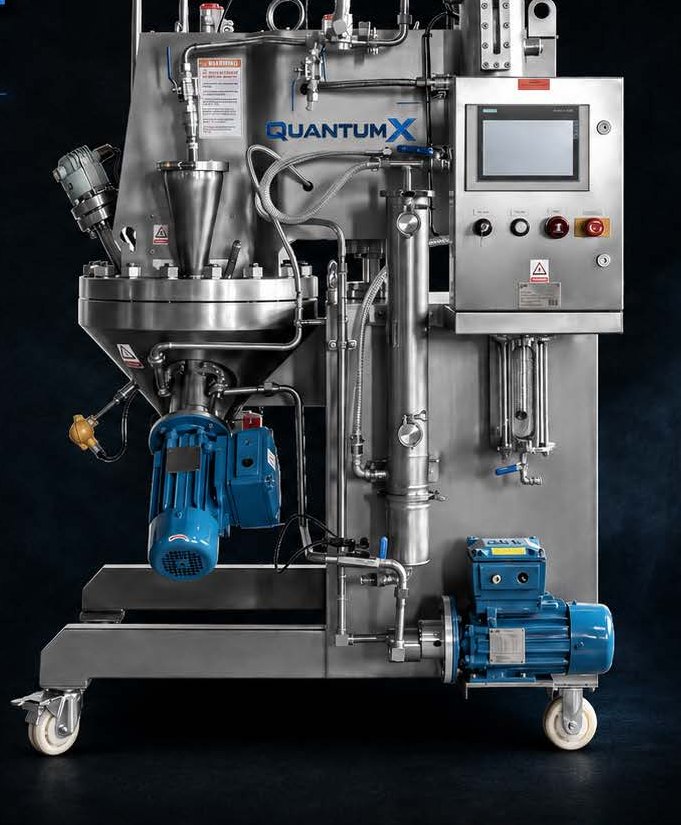
| Ancillaries | Feeders, dust filter | Vacuum pump, condenser, receiver, cold trap, filter |
| Moisture removal | None | To below 0.1% w/w, product-dependent |
| Solvent recovery | Not applicable | Closed-loop condensation and reuse |
| Heat-sensitive product | Handled by cooling only | Dries at 30 – 50 °C product temperature |
| Oxidation / dust risk | Managed by inert purge | Evacuate and N₂ back-fill; inherently oxygen-free |
| Cycle time | 3 – 20 min | 2 – 12 h including drying |
| Installed power, 1,000 L | 11 kW | 18.5 kW plus vacuum skid |
| Relative capital | Baseline | 2.5 – 4× baseline, ancillaries included |
| Replaces | — | A separate mixer, tray/fluid-bed dryer and the transfer between them |
| Choose it when | The product arrives dry and leaves dry | Moisture, solvent, oxygen or heat sensitivity is part of the specification |
Horizontal Vacuum Ribbon Mixers/Dryers · PRBD Series
Dimensions in mm and exclude the vacuum pump, condenser and receiver skid. kW and RPM shown are for jacketed vacuum execution and vary with product viscosity and drying duty. Mixers can be built to a total volume of up to 30,000 L.
| Model | Total L | Work. 40% | Work. 60% | kW | RPM | L | W | H | kg |
|---|---|---|---|---|---|---|---|---|---|
| PRBD-5L-CP | 5 | 2 | 3 | 1.1 | 256 | 950 | 900 | 610 | 140 |
| PRBD-10L-CP | 10 | 4 | 6 | 1.1 | 256 | 1,050 | 900 | 610 | 160 |
| PRBD-15L-CP | 15 | 6 | 9 | 2.2 | 196 | 1,150 | 1,000 | 640 | 180 |
| PRBD-20L-CP | 20 | 8 | 12 | 2.2 | 196 | 1,250 | 1,050 | 670 | 210 |
| PRBD-30 | 30 | 12 | 18 | 3 | 86 | 940 | 950 | 1,130 | 330 |
| PRBD-45 | 45 | 18 | 27 | 3 | 86 | 940 | 1,000 | 1,160 | 340 |
| PRBD-50 | 50 | 20 | 30 | 4 | 77 | 1,000 | 1,050 | 1,200 | 460 |
| PRBD-60 | 60 | 24 | 36 | 4 | 77 | 1,000 | 1,100 | 1,200 | 590 |
| PRBD-70 | 70 | 28 | 42 | 4 | 60 | 1,150 | 1,130 | 1,250 | 720 |
| PRBD-100 | 100 | 40 | 60 | 4 | 60 | 1,410 | 750 | 1,650 | 780 |
| PRBD-150 | 150 | 60 | 90 | 5.5 | 56 | 1,450 | 800 | 1,680 | 810 |
| PRBD-200 | 200 | 80 | 120 | 5.5 | 49 | 1,590 | 810 | 1,710 | 850 |
| PRBD-250 | 250 | 100 | 150 | 7.5 | 46 | 1,750 | 850 | 1,750 | 910 |
| PRBD-300 | 300 | 120 | 180 | 7.5 | 46 | 1,825 | 865 | 1,760 | 980 |
| PRBD-400 | 400 | 160 | 240 | 11 | 42 | 1,900 | 950 | 1,900 | 1,110 |
| PRBD-500 | 500 | 200 | 300 | 11 | 42 | 2,010 | 1,020 | 2,020 | 1,240 |
| PRBD-600 | 600 | 240 | 360 | 15 | 42 | 2,200 | 1,050 | 2,090 | 1,370 |
| PRBD-700 | 700 | 280 | 420 | 15 | 42 | 2,300 | 1,070 | 2,100 | 1,500 |
| PRBD-750 | 750 | 300 | 450 | 15 | 42 | 2,355 | 1,110 | 2,150 | 1,630 |
| PRBD-800 | 800 | 320 | 480 | 18.5 | 36 | 2,400 | 1,150 | 1,765 | 1,760 |
| PRBD-1000 | 1000 | 400 | 600 | 18.5 | 28 | 2,500 | 1,200 | 1,765 | 1,890 |
| PRBD-1200 | 1200 | 480 | 720 | 22 | 28 | 2,650 | 1,250 | 1,800 | 2,080 |
| PRBD-1500 | 1500 | 600 | 900 | 22 | 28 | 2,850 | 1,300 | 1,870 | 2,210 |
| PRBD-2000 | 2000 | 800 | 1200 | 22 | 25 | 3,020 | 1,400 | 1,980 | 2,930 |
| PRBD-2500 | 2500 | 1000 | 1500 | 30 | 25 | 3,200 | 1,500 | 2,100 | 3,380 |
| PRBD-3000 | 3000 | 1200 | 1800 | 30 | 25 | 3,400 | 1,550 | 2,150 | 3,640 |
Vertical Vacuum Ribbon Mixers/Dryers · PVRD Series
Dimensions in mm and exclude the vacuum skid. Working volumes at 30% and 70% of total.
| Model | Total L | Work. 30% | Work. 70% | kW | RPM | Dia. | H | kg |
|---|---|---|---|---|---|---|---|---|
| PVRD-15 | 15 | 4 | 10 | 1.5 | 92 | 450 | 1800 | 180 |
| PVRD-20 | 20 | 6 | 14 | 1.5 | 77 | 550 | 2100 | 240 |
| PVRD-30 | 30 | 9 | 21 | 2.2 | 77 | 550 | 2100 | 340 |
| PVRD-45 | 45 | 14 | 32 | 2.2 | 68 | 655 | 2200 | 420 |
| PVRD-50 | 50 | 15 | 35 | 2.2 | 68 | 655 | 2200 | 480 |
| PVRD-60 | 60 | 18 | 42 | 2.2 | 66 | 720 | 2200 | 540 |
| PVRD-70 | 70 | 21 | 49 | 3 | 65 | 720 | 2200 | 660 |
| PVRD-100 | 100 | 30 | 70 | 3 | 59 | 720 | 2200 | 720 |
| PVRD-150 | 150 | 45 | 105 | 4 | 53 | 875 | 2500 | 840 |
| PVRD-200 | 200 | 60 | 140 | 4 | 48 | 875 | 2500 | 960 |
| PVRD-250 | 250 | 75 | 175 | 5.5 | 45 | 980 | 2200 | 550 |
| PVRD-300 | 300 | 90 | 210 | 5.5 | 43 | 980 | 2200 | 590 |
| PVRD-400 | 400 | 120 | 280 | 7.5 | 37 | 1160 | 2400 | 650 |
| PVRD-500 | 500 | 150 | 350 | 7.5 | 37 | 1160 | 2400 | 720 |
| PVRD-600 | 600 | 180 | 420 | 7.5 | 34 | 1500 | 2600 | 910 |
| PVRD-700 | 700 | 210 | 490 | 11 | 33 | 1500 | 2600 | 1070 |
| PVRD-750 | 750 | 225 | 525 | 11 | 33 | 1500 | 2600 | 1240 |
| PVRD-800 | 800 | 240 | 560 | 11 | 30 | 1500 | 2600 | 1370 |
| PVRD-1000 | 1000 | 300 | 700 | 15 | 28 | 1525 | 3000 | 1430 |
| PVRD-1200 | 1200 | 360 | 840 | 15 | 26 | 1680 | 3200 | 1560 |
| PVRD-1500 | 1500 | 450 | 1050 | 18.5 | 25 | 1680 | 3200 | 1690 |
| PVRD-2000 | 2000 | 600 | 1400 | 22 | 25 | 1860 | 3600 | 1890 |
| PVRD-2500 | 2500 | 750 | 1750 | 22 | 20 | 2000 | 3700 | 1950 |
| PVRD-3000 | 3000 | 900 | 2100 | 30 | 20 | 2080 | 3900 | 2080 |
| PVRD-4000 | 4000 | 1200 | 2800 | 37 | 20 | 2300 | 4100 | 3320 |
In the Shop & In the Field
Vacuum Drying Questions, Answered
At what temperature does a vacuum dryer dry product?
At 10–100 mbar absolute pressure, water boils between 7 °C and 46 °C — so most products dry at 30–50 °C product temperature. Heat-sensitive materials such as proteins, probiotics and APIs retain activity, colour and aroma.
What final moisture can a vacuum ribbon dryer reach?
Below 0.1% w/w on most products, and single-digit ppm moisture for battery-grade materials under deep vacuum with nitrogen back-fill. Evaporation rates typically run 4–12 kg/m²·h with cycle times of 2–12 hours including drying.
Can solvents be recovered instead of vented?
Yes. A closed-loop vapour system — condenser, receiver and cold trap sized to the evaporation duty — recovers solvents as liquid for reuse. This is standard practice for API, NMP and specialty chemical duties.
What does a vacuum mixer/dryer replace?
A separate mixer, a tray or fluid-bed dryer, and the product transfer between them — along with the exposure, loss and re-segregation that transfer causes. One vessel handles mixing, reaction or granulation, drying and cooling.
Moisture, Solvent, Oxygen or Heat Sensitivity in Your Spec?
Then the vacuum execution earns its capital. Send us the product, the target LOD and the solvent — we'll size the vessel, the jacket and the vapour system, and prove the cycle in trial.
Discuss Your Drying Application