
Vacuum Double Cone Mixers & Dryers
Two cones joined at the cylinder, rotating end-over-end under vacuum. No internal agitator, no shaft seal in the product zone, nothing to shear a crystal — the reference geometry for drying APIs, fine chemicals and fragile crystalline products where purity and particle integrity govern everything.
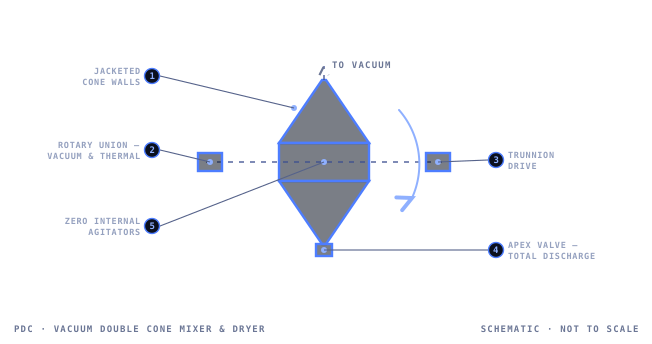
The Mixing Action
Tumble Blending
The whole vessel rotates, cascading product gently through itself. Mixing energy is minimal and shear is essentially zero — crystals, needles and friable granules survive intact.
Jacketed Cone Walls
The full cone surface is jacketed; rotation continuously renews the product layer at the heated wall. Vacuum and heating services pass through a rotary union on the trunnion.
Sealed, Polished, Validatable
One product-contact volume with no internal dead spots, polished to Ra ≤ 0.4 µm on pharma duty — fast validated cleaning between campaigns and total discharge through the apex valve.
Where the PDC Series Earns Its Place
Strengths
- Zero-shear drying — crystal habit and particle size preserved
- No internal shaft or seal in the product zone
- Total discharge and fast validated cleaning
- Intensifier bar option where light de-lumping is needed
- Loading/unloading under nitrogen for oxygen-sensitive product
Typical Duties
- API and intermediate final drying to target LOD
- Solvent removal and recovery from crystalline product
- Fine chemical and specialty powder drying
- Low-shear blending of fragile or segregating products
- Deaeration and degassing under deep vacuum
Industries
- Pharmaceutical & API
- Fine chemicals
- Nutraceutical crystals
- Specialty materials
Standard sizes, working volumes, heated areas and installed power for the PDC Series are issued as an engineering datasheet, matched to your material. Request the PDC datasheet »
Tumble vacuum dryers are a decades-old category quoted on volume and RPM. QuantumX quotes the drying physics: jacketed area per litre, rotation speed against your product's flow regime, evaporation rate at your vacuum level and solvent, and a trial-proven cycle time — with FAT against the same criteria.
Mix, Dry, React — One Vessel, Under Vacuum
At 10–100 mbar absolute, water boils between 7 °C and 46 °C — so heat-sensitive product dries at temperatures a conventional dryer cannot approach. Every QuantumX vacuum machine shares the same engineering: ASME jackets, vacuum-rated bodies, closed-loop solvent recovery, nitrogen back-fill for oxygen-free processing, and product-temperature control with full batch data logging. How vacuum drying works »
One Vessel, Three Duties
Mix, react or granulate, then dry to spec — no transfer, no loss, no re-segregation.
Solvent Recovery
Condenser, receiver and cold trap sized to the duty; solvents come back as liquid.
Oxygen-Free
Evacuate and back-fill with N₂; ATEX and inert-loop control available.
Validated Cycles
Drying curve and endpoint measured in trial, warranted at FAT.
Double cone blenders are also built as standard atmospheric mixers — the same engineered geometry, jacket options and trial validation, without the vacuum train. Specify at enquiry.
In the Shop & In the Field
Double Cone Dryers, Answered
What is a double cone vacuum dryer?
A rotating double-cone vessel, jacketed and vacuum-rated. Product tumbles gently through itself while the heated wall and low absolute pressure remove moisture or solvent — with no internal agitator to damage crystals.
Why choose a double cone over an agitated vacuum dryer?
When shear is the enemy: crystalline APIs, needles, coated particles and friable granules. The double cone drives moisture off with zero mechanical stress and cleans faster because there is no internals package.
How is heat applied to a rotating vessel?
Thermal fluid circulates through the cone jacket via a rotary union on the trunnion; vacuum is drawn through the same union on the opposite side, typically with a dust filter at the vessel port.
Explore the full range: all vacuum powder mixers & dryers »
Prove It on Your Material First
Pilot trial, your product, measured drying curve and blend data — then geometry, thermal and vacuum scope fixed, and FAT against the same criteria.
Request a Quote