
Vacuum Drum Mixers & Dryers
A rotating, jacketed drum with engineered internal flights, running under vacuum. The simplest possible product path — no shafts, no seals in the powder zone, one polished surface — for very gentle drying and blending of granules, catalysts and coated particles at large volume.
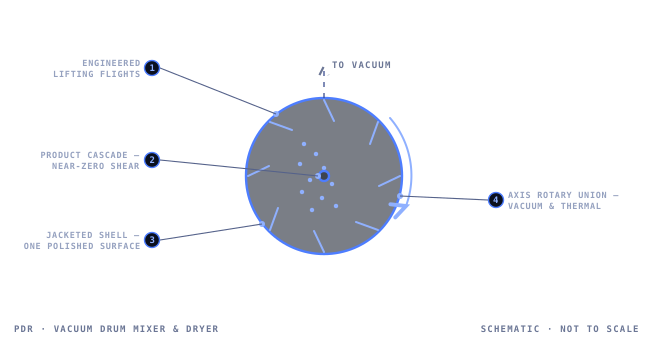
The Mixing Action
Cascade Turnover
Internal flights lift product and shower it through the drum cross-section as the vessel turns — continuous surface renewal at near-zero shear.
Jacketed Shell
The full drum shell is jacketed; rotation keeps fresh product against the heated wall while vacuum removes moisture at low product temperature.
Nothing to Hide
No internal shaft, no product-zone seal, no dead zone. Inspection, cleaning and validation reduce to one open, polished surface.
Where the PDR Series Earns Its Place
Strengths
- Near-zero shear — coated and friable particles survive
- Simplest cleaning and inspection of any mixer/dryer class
- Large single-batch volumes at modest installed power
- Uniform drying via continuous cascade renewal
- Inert operation and solvent recovery available
Typical Duties
- Catalyst and molecular-sieve drying and activation
- Gentle blending and drying of coated granules
- Free-flowing chemical and mineral powders
- Degassing and deaeration at volume
- Post-coating conditioning duties
Industries
- Catalysts & adsorbents
- Specialty chemicals
- Ceramics & minerals
- Food granules
Standard sizes, working volumes, heated areas and installed power for the PDR Series are issued as an engineering datasheet, matched to your material. Request the PDR datasheet »
Rotary vacuum dryers are often treated as commodity drums. QuantumX engineers the flight profile against your product's flow behaviour and quotes evaporation rate, fill fraction and cycle time from trial data — the difference between a drum and a dryer.
Mix, Dry, React — One Vessel, Under Vacuum
At 10–100 mbar absolute, water boils between 7 °C and 46 °C — so heat-sensitive product dries at temperatures a conventional dryer cannot approach. Every QuantumX vacuum machine shares the same engineering: ASME jackets, vacuum-rated bodies, closed-loop solvent recovery, nitrogen back-fill for oxygen-free processing, and product-temperature control with full batch data logging. How vacuum drying works »
One Vessel, Three Duties
Mix, react or granulate, then dry to spec — no transfer, no loss, no re-segregation.
Solvent Recovery
Condenser, receiver and cold trap sized to the duty; solvents come back as liquid.
Oxygen-Free
Evacuate and back-fill with N₂; ATEX and inert-loop control available.
Validated Cycles
Drying curve and endpoint measured in trial, warranted at FAT.
Drum mixers are also built as standard atmospheric mixers — the same engineered geometry, jacket options and trial validation, without the vacuum train. Specify at enquiry.
In the Shop & In the Field
Drum Mixer Dryers, Answered
What is a vacuum drum dryer?
A rotating jacketed drum with internal lifting flights, operated under 10–200 mbar. Product cascades gently through its own volume while the heated shell and low pressure remove moisture — with no internal agitator at all.
What products suit a drum mixer dryer?
Free-flowing granules, catalysts, adsorbents, coated particles — anything that benefits from surface renewal without mechanical shear.
How does it compare to a double cone?
Both are zero-shear tumble geometries. The drum offers larger single-batch volumes and engineered flight control of the cascade; the double cone offers total discharge geometry and the classic pharma validation path.
Explore the full range: all vacuum powder mixers & dryers »
Prove It on Your Material First
Pilot trial, your product, measured drying curve and blend data — then geometry, thermal and vacuum scope fixed, and FAT against the same criteria.
Request a Quote