
Vacuum Planetary Mixers & Dryers
Two (or three) blades orbit the vessel while rotating on their own axes, sweeping the full volume of pastes from 50,000 to over 6 million centipoise. Under vacuum, the same machine deaerates, dries and densifies — the reference geometry for battery slurries, adhesives, sealants and energetic formulations.
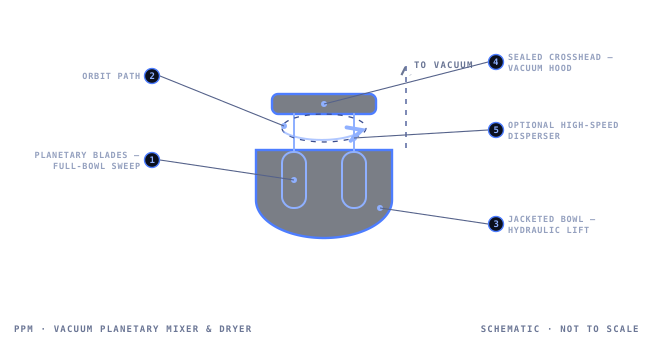
The Mixing Action
Planetary Sweep
Orbiting blades contact the entire vessel volume in a few revolutions — no dead zones, no reliance on product flow, full mixing at any viscosity that will yield.
Vacuum Deaeration
At ≤ 10 mbar entrained air and dissolved gases leave the paste — the difference between a battery electrode that coats clean and one that pinholes.
High-Speed Disperser Option
A coaxial disperser shaft adds powder-wetting and particle-dispersion energy inside the planetary sweep — solids loading climbs without sacrificing uniformity.
Where the PPM Series Earns Its Place
Strengths
- Full-volume mixing independent of product flow behaviour
- Deep-vacuum deaeration to ≤ 10 mbar
- Jacketed bowl for heating, cooling and drying duties
- Hydraulic bowl clamp and lift for fast changeover
- Explosion-proof and inert execution for solvent systems
Typical Duties
- Battery electrode slurry mixing and deaeration
- Adhesives, sealants and potting compounds
- Ointments, gels and high-viscosity cosmetics
- Energetic and pyrotechnic formulations
- Solvent-borne coating pastes with recovery
Industries
- Battery & energy
- Adhesives & sealants
- Pharmaceutical semi-solids
- Defense & energetics
Standard sizes, working volumes, heated areas and installed power for the PPM Series are issued as an engineering datasheet, matched to your material. Request the PPM datasheet »
Planetary vacuum mixers are quoted everywhere; validated paste outcomes are not. QuantumX proves your viscosity curve, deaeration endpoint and temperature window on a pilot machine, then builds the production unit to the same numbers — blades, bowl, vacuum train and controls from one manufacturer.
Mix, Dry, React — One Vessel, Under Vacuum
At 10–100 mbar absolute, water boils between 7 °C and 46 °C — so heat-sensitive product dries at temperatures a conventional dryer cannot approach. Every QuantumX vacuum machine shares the same engineering: ASME jackets, vacuum-rated bodies, closed-loop solvent recovery, nitrogen back-fill for oxygen-free processing, and product-temperature control with full batch data logging. How vacuum drying works »
One Vessel, Three Duties
Mix, react or granulate, then dry to spec — no transfer, no loss, no re-segregation.
Solvent Recovery
Condenser, receiver and cold trap sized to the duty; solvents come back as liquid.
Oxygen-Free
Evacuate and back-fill with N₂; ATEX and inert-loop control available.
Validated Cycles
Drying curve and endpoint measured in trial, warranted at FAT.
Planetary mixers are also built as standard atmospheric mixers — the same engineered geometry, jacket options and trial validation, without the vacuum train. Specify at enquiry.
In the Shop & In the Field
Planetary Mixer Dryers, Answered
What viscosity can a planetary mixer handle?
Double planetary geometry works from low-viscosity liquids to pastes above 6 million cP; blade profile and speed are selected against your rheology curve, not a catalog average.
Why mix battery slurry under vacuum?
Entrained air causes coating defects and inconsistent density. Mixing and deaerating at 10 mbar or below in the same bowl produces a pinhole-free, stable slurry without a separate degassing step.
Can a planetary mixer dry product?
Yes — with a jacketed bowl and vacuum, solvent is stripped and recovered during or after mixing, taking a paste to a dough or a dry crumb in one vessel.
Explore the full range: all vacuum paste mixers & dryers »
Prove It on Your Material First
Pilot trial, your product, measured drying curve and blend data — then geometry, thermal and vacuum scope fixed, and FAT against the same criteria.
Request a Quote