
Vacuum Sigma Mixers & Dryers
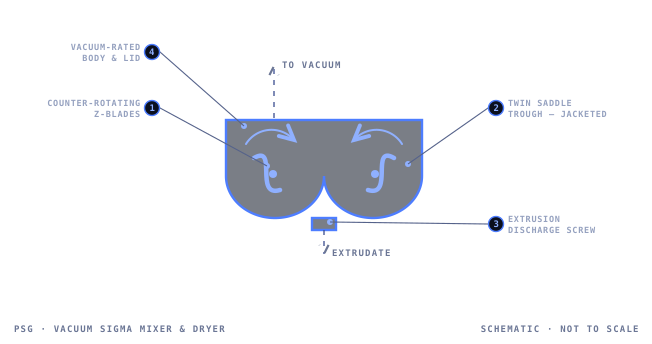
Two Z-shaped blades counter-rotate in a twin-trough saddle body, kneading, shearing and folding the heaviest doughs and masses made — under vacuum, with a jacketed body, and with an optional discharge screw that empties the trough without opening it. When the product fights back, this is the machine.
The Mixing Action
Z-Blade Kneading
The tangential or overlapping Z-blades compress, stretch and fold the mass against the saddle — dispersive and distributive mixing for materials far beyond stirrable viscosity.
Vacuum & Thermal Body
Jacketed troughs and low absolute pressure devolatilise, dry and deaerate during kneading — solvent leaves as the mass develops, and is recovered on the condenser.
Extrusion Discharge
An optional bottom discharge screw extrudes the finished mass through a die — total discharge of product too stiff to pour, without tilting or manual digging.
Where the PSG Series Earns Its Place
Strengths
- Handles masses no other geometry can move
- Devolatilise, dry and knead simultaneously
- Discharge screw empties stiff product completely
- Hardfaced blades and body for abrasive compounds
- Reaction duty with controlled jacket heat input
Typical Duties
- Electrode and carbon pastes
- Silicone, butyl and sealant masses
- Chewing-gum and confectionery bases
- Energetic compositions and propellant doughs
- Ceramic bodies and technical putties
Industries
- Battery & carbon products
- Sealants & rubber compounds
- Food & confectionery bases
- Defense & energetics
- Technical ceramics
Standard sizes, working volumes, heated areas and installed power for the PSG Series are issued as an engineering datasheet, matched to your material. Request the PSG datasheet »
Sigma kneaders are old technology sold on horsepower. QuantumX sizes blade geometry and clearance from your mass's rheology, quotes torque and thermal duty from trial, and configures vacuum, discharge and containment around your actual process — not a catalog page.
Mix, Dry, React — One Vessel, Under Vacuum
At 10–100 mbar absolute, water boils between 7 °C and 46 °C — so heat-sensitive product dries at temperatures a conventional dryer cannot approach. Every QuantumX vacuum machine shares the same engineering: ASME jackets, vacuum-rated bodies, closed-loop solvent recovery, nitrogen back-fill for oxygen-free processing, and product-temperature control with full batch data logging. How vacuum drying works »
One Vessel, Three Duties
Mix, react or granulate, then dry to spec — no transfer, no loss, no re-segregation.
Solvent Recovery
Condenser, receiver and cold trap sized to the duty; solvents come back as liquid.
Oxygen-Free
Evacuate and back-fill with N₂; ATEX and inert-loop control available.
Validated Cycles
Drying curve and endpoint measured in trial, warranted at FAT.
Sigma kneaders are also built as standard atmospheric mixers — the same engineered geometry, jacket options and trial validation, without the vacuum train. Specify at enquiry.
In the Shop & In the Field
Sigma Kneader Dryers, Answered
What is a sigma blade mixer?
A double-arm kneader whose Z-shaped blades counter-rotate in a saddle-bottom trough — the standard machine for doughs, pastes and masses too stiff for planetary or paddle geometries. The vacuum execution adds devolatilisation, drying and deaeration.
How does a sigma kneader discharge stiff product?
By hydraulic tilt, or by an integral discharge screw in the trough saddle that extrudes the finished mass through a die — total discharge without manual digging.
Can it run reactions?
Yes. The jacketed, vacuum-rated body with controlled heat input and vapour recovery supports reaction, devolatilisation and polymer finishing duties.
Explore the full range: all vacuum paste mixers & dryers »
Prove It on Your Material First
Pilot trial, your product, measured drying curve and blend data — then geometry, thermal and vacuum scope fixed, and FAT against the same criteria.
Request a Quote